

There's a building tension. Apparent is the cold breath emanating from my rivals as they execute the "about to run" wiggle on the start line.
A swift flick of the hips.
I'm participating in my local 5km community parkrun and I mean business. It's almost time...
Wait a second. I have to adjust my device. So does the runner next to me.
The person in the line tuts. I'm not moving until… there! GPS ready, and I'm running.
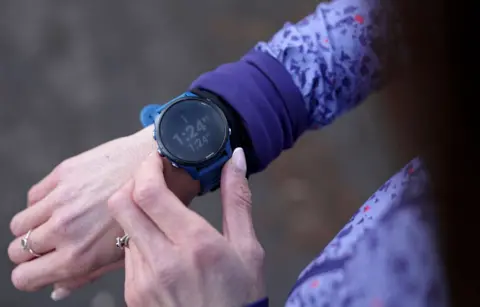
Amidst the crowd, it's difficult to find a arm without a smartwatch on it. And it's not just us runners who rely on them.
This is a thriving, multi-billion pound sector. Companies like Apple Watch lead the market, each with an broad range of diverse devices to cater to a variety of needs. Based on how advanced the model you go for, price tags can vary between a hundred pounds to a small fortune.
"It drives me insane, I'm unable to stop checking."
"It comforts me… It's like a companion encouraging me."
"Stop telling me I've experienced a bad night's sleep."
A small sample of the reactions I've received from like-minded tracker enthusiasts when I ask what they feel about theirs.
The Data Dilemma
My current opinion on my own device? Currently, frustrating. It's reporting I'm not hitting my target, leading me to doubt whether the foliage I'm running below are interfering with my satellite signal.
Millions of us attach these compact devices onto our wrists and wear them all day and night, ostensibly at ease with the fact they're continuously recording us.
Long past are the days when we used them solely to give us an idea of our pedometer reading. Today, they can analyse our sleep quality, stress levels, oxygen saturation, our recovery score.
It's a challenge to find a health indicator they don't track.
But can they do what they say they do? And are the statistics we scrutinise a faithful picture of our actual health? Do they boost our daily wellness, or do the plethora of metrics and constant notifications just increase our everyday anxiety?

A Complicated Bond
"I find myself getting a quite obsessed with mine," a wearer reveals.
While she loves how her device tracks her exercise, she finds some of its other features "overwhelming" at times - a feeling first discovered during a major life event.
Before she realised she could change its configuration, her smartwatch constantly alerted her she was failing to be productive enough. Later on, the watch insists her she's had a bad night's sleep.
"I am caring for a six-month old, I don't need to be notified I've not slept," she says. "That fact is only too well."
Why doesn't she just stop wearing it?
"I suppose I could, perhaps, but I'm in this love-hate relationship with it," she says. "I value it for its fitness insights, but I'm unsure whether all the other things it can now do is perhaps overkill for me."
Inside the Device
Different brands of smartwatch has its own novel way of tracking your bodily functions and interpreting your data, but the vast bulk use optical sensors on the underside of the watch.
They typically emit minute LED lights onto your wrist which can monitor pulsation, recording your pulse rate. Higher-end devices measure changes in the skin conductance that flows through the skin to get an idea of your recovery state.
The Professional Viewpoint
A professor says that in general for smartwatches, it's a "fine balance" - while the rapidly advancing tech could realistically aid early diagnosis, "spotting abnormalities before we notice anything", it could also turn us watch wearers into the "concerned but fine".
He points out that newer wearables can conduct tests like heart rhythm analysis, which continuously monitor how healthy the heart is. They can alert if someone is experiencing atrial fibrillation (AF), where there is abnormal signals in the heart causing an uneven pulse.
This does not automatically signal someone is on the verge of a cardiac event, but it can give an preliminary indication they might be more vulnerable of a stroke in the long term.
But how to make sense of these readings is complex. The expert worries that as more functions are added, people may not be able to fully contextualise their data.
"I remain sceptical that having the capacity to monitor so many things is such a positive development," he says.
A professor focusing on wearable tech agrees. A study into the effect of wearable tech on a specific group of heart condition patients suggested a noticeable percentage of those who were given devices to monitor their heart health experienced greater stress and were "more inclined to use healthcare resources".
She identified a cycle with her patients - they noticed a worrying figure on their watch. They became worried. Their pulse rose. They got more worried. They looked a second time, and their anxiety increased again.
"If we see stats about ourselves that we can't properly interpret then, naturally, we are going to become concerned," the psychologist says. "We check, we obsess - it becomes a feedback loop."


